Dogs | Accessories
Best Dog Stairs for Small Dogs in Australia, Ranked
A small dog throwing itself off the edge of the bed looks like nothing — until it's an older dog landing badly, or a dachshund doing it for the thousandth time. That short drop onto a hard floor is a real jolt through little legs and long backs, and it adds up. A good set of dog stairs turns the leap into a walk, so a puppy, a senior or a short-legged breed can reach the couch or bed and get back down without the impact. The catch is that a stair built for a chihuahua is not the one built for a high bed or the back of the car. We've compared four dog stairs and ramps you can buy in Australia right now, and worked out which dog and which piece of furniture each one suits.
Best Overall

COZY KISS Curved Dog Stairs
- Gentle curved climb on joints
- Leakproof washable cover
- Small and medium dogs only
Best Budget Foam Set

Anshine 3-Tier Dog Stairs
- Affordable, cushioned foam steps
- Light, easy to move around
- Basic three-step foam build
Best for High Beds

LOMORA 5-Tier Dog Stairs
- Tall enough for high beds
- Widened steps feel more stable
- A big unit in a small room
Best for Travel

Foldable 3-Step Dog Stairs
- Folds flat for the car
- Dirt-repellent cover
- Firmer than foam steps

What separates a set of stairs a dog trusts from one it steps around comes down to a handful of things — how gentle the climb is on small joints, how stable it sits underfoot, how well the height matches real furniture, and how easily it cleans and stores. Stairs take the daily jump out of a small dog's routine, and for an older dog they pair well with our guide to joint supplements for dogs.
What to look for in a dog staircase
Five things worth weighing before you buy, so the steps match your dog and your furniture. Swipe through all five.
Match the height
Measure the drop from the floor to the bed or couch before anything else. A staircase that's too short leaves a gap the dog still has to jump, and one that's too tall becomes a steep climb they'll quietly avoid.
Step depth and rise
Small dogs have short legs, so shallow, deep steps are kinder than tall, narrow ones. A gentle rise per step, or a sloped ramp, asks far less of stiff hips and long backs than a big vertical hop between tiers.
Grip top to bottom
The surface the dog climbs and the base on the floor both need to hold. A non-slip tread stops paws skating on the way up, while a gripped or rubber-dotted base keeps the set from sliding out as the dog pushes off.
Foam or firm folding
Foam is softer and warmer underfoot and suits sore joints, but it can’t fold and won’t shrug off a muddy paw. A firm folding set folds flat and wipes clean for travel and outdoors, at the cost of a firmer, cooler step.
Cleaning and washing
Puppies and older dogs have accidents, so a removable, washable cover earns its keep. Check whether the cover is waterproof or leakproof, and whether only the sleeve washes, since most foam cores can't go near a machine.
At a glance
The four picks side by side on height, build and price, with the short version of our verdict on each.
| Rank | Product | Best for | Key feature | Price guide | Check price |
|---|---|---|---|---|---|
| Best Overall |  | Small dogs and joint protection | Curved foam slope, leakproof washable cover | $$$ | Check price |
| Best Budget Foam Set |  | The cheapest cushioned foam set | Memory foam, non-slip textured surface | $$ | Check price |
| Best for High Beds |  | Tall beds and car boots | 60cm tall, widened steps, rubber-dot base | $$$ | Check price |
| Best for Travel |  | Travel, storage and outdoor use | Folds flat for the car; firm three-step board with a textured hessian tread | $$ | Check price |
Our picks in detail
What we rate, what to watch for, and the dog each set suits.
Best Overall: COZY KISS Curved Dog Stairs
Bottom line — the gentlest all-rounder for a small dog, with a curved climb and a leakproof cover made for accidents.
The curve is the whole idea here, and it's a good one. Instead of asking a small dog to hop up square-edged steps, the surface slopes like a gentle ramp with just enough tread to stop paws sliding, which is easier on stiff hips and long backs than a straight drop between tiers. A 30D high-density foam core holds its shape under a small dog instead of sagging into a hammock.
The cover is where it earns the top spot in a house with a puppy or an ageing dog. It's a leakproof, machine-washable sleeve over the foam, so the odd accident wipes and washes off instead of soaking in, and a non-slip nylon base keeps the whole thing from skating across floorboards when the dog commits. You stack it to the height you need — a couple of layers for a chair, more for a bed — and there's a handle for shifting it. It suits small and medium dogs only, and the foam wants a day or two to fully expand out of the box.
| What we love | Areas for improvement |
|---|---|
|
|
Best Budget Foam Set: Anshine 3-Tier Dog Stairs
Bottom line — the cheapest of the cushioned-foam sets, getting a small dog off the floor without spending much.
Not everyone needs a fancy set of steps, and this is the one to start with if you just want your dog off the floor. It's a simple three-tier block of 30D memory foam with a textured, non-slip cover, sized to bridge the gap up to a couch or a lower bed. Nothing clever, but the foam is firm enough to take a small dog's weight without folding under it.
The whole thing is light, so it's easy to shift from the lounge to the bedroom or lift into the car, and the cover pulls off for a machine wash when it gets grubby — though the foam core itself can't go in, so a spill needs blotting rather than soaking. Three tiers suits small dogs and a low-to-standard bed; it won't reach a tall bed, and a bigger dog will squash it flat. For the money, it does the one job that matters, which is turning a jump into a few easy steps, and it's a sensible way to find out whether your dog will use stairs at all before spending more.
| What we love | Areas for improvement |
|---|---|
|
|
Best for High Beds: LOMORA 5-Tier Dog Stairs
Bottom line — the tall, wide set for a high bed or the car boot, giving a small dog a stable way up.
Some beds and most car boots are too tall for a three-step foam block, and that's the gap this fills. At 60cm over five steps it reaches proper high-bed height, and the steps are cut about 5cm wider than a standard set, so a smaller dog has room to place its feet instead of balancing along a too-narrow step. The same 30D foam keeps each step firm underfoot.
Wider and taller reassures a dog that hesitates on a steep climb, and a non-slip base with rubber dots keeps it planted when the dog pushes off the top step. It comes in a four-step version for a sofa or lower bed and the five-step for a high bed or the car, so match the height to the drop instead of defaulting to the tallest — a five-step stack has the steepest rise per step here, so a stiff or tiny dog does better on the shortest set that reaches. The catch is bulk: a 60cm staircase is a real piece of furniture in a small bedroom. For a genuinely high bed, though, nothing else here reaches.
| What we love | Areas for improvement |
|---|---|
|
|
Best for Travel: Foldable 3-Step Dog Stairs
Bottom line — the pick that folds flat for the car or a cupboard, if you can trade foam’s softness for a firmer, dirt-repellent board.
Foam steps are comfy but they don’t fold, so for a set that has to travel or tuck away in a cupboard, this folding three-step design wins. It collapses flat, clips shut with Velcro, and pops back open in a second, then stands ready beside a couch, a bed, or the back of the car. The steps are firm high-density board with a textured hessian tread on a non-slip base, so they hold their shape rather than compressing like foam.
The appeal is packability — it folds into the boot for a trip away, and the hessian cover is dirt-repellent for outdoor use. The trade-off is the feel underfoot: firm board steps don’t give the way foam does, and they sit a touch steeper than the cushioned foam sets here, so a dog with sore joints or a wobbly senior may prefer foam’s softness, and a nervous dog can take a little longer to trust the firmer tread. For travel and easy storage, though, it’s the most convenient pick here.
| What we love | Areas for improvement |
|---|---|
|
|
FAQ
Are dog stairs better than a ramp for a small dog?
What size dog stairs do I need?
Will my dog use these stairs?
Do puppies need dog stairs too?
Can dog stairs help a dog with arthritis?
Final thoughts
If there's one thing I'd sort out before buying, it's careful measuring — the height of the bed or couch, and the size of the dog. Most of the grief people have with dog stairs comes from a set that's too tall, too steep or too narrow for the dog it was bought for, so it sits in the corner gathering hair while the dog keeps jumping anyway. Measure the drop, match the step height to the length of your dog's legs, and set it down at the exact spot the dog already jumps up.
Pepper, my staffy, would treat any of these as a launch pad and clear it in one bound, so I'll be upfront that stairs are really for the little and the older dogs — the puppies, the short-legged breeds and the seniors whose joints have done enough jumping. If that's your dog, the best set is the one they'll use, which usually means the lowest, widest, most stable one that still reaches the furniture. Walk a nervous dog up and down it a few times with a treat and a bit of patience, and most of them work it out faster than you'd think. And if an older dog is suddenly struggling with steps it used to manage, that's a vet conversation about the joints as much as a furniture problem.
We Think You’ll Also Like These Guides
 DOG
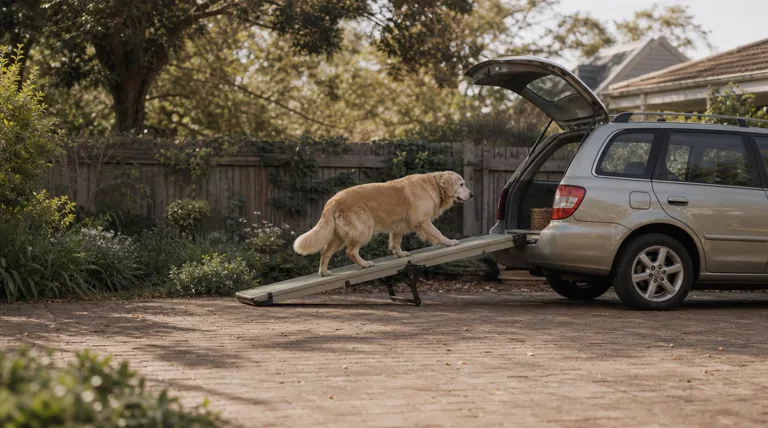
DOGBest Dog Ramps for Senior and Large Dogs in Australia
An old or big dog shouldn't have to leap into the car. A good ramp turns the jump into a walk — here are four, matched to seniors, big breeds, tall…

 DOG
DOG4Cyte vs Antinol for Dogs: What the Dog Trials Show
Two premium joint oils on very different evidence. We compare the dog trials, what each capsule and gel really contains, and the cost of keeping…

 DOG
DOG4Cyte vs Rose-Hip Vital: Which Dog Joint Supplement Wins?
Same orange tubs, opposite ideas. We compare Rose-Hip Vital and 4Cyte on research, cost and which suits your dog’s stage.