Dogs | Bedding
Best Orthopaedic Dog Beds in Australia for Senior Dogs of Every Size
A stiff, older dog telling you the floor is too hard is easy to miss — they just stop settling, circle more, and take longer to get up after a nap. A proper orthopaedic dog bed fixes the thing underneath them: dense foam that holds a big dog's weight instead of bottoming out onto the boards. The support is the whole point — cushioning that eases pressure on hips, elbows and shoulders, since a soft pad just flattens by winter. You manage arthritis in older dogs; you do not cure it, and alongside veterinary care the RSPCA points to simple changes at home, like avoiding stairs and covering slippery floors. A bed that supports the joints belongs in that same kit.
Best Overall

BFPETHOME Orthopedic Waterproof Sofa Dog Bed
- Egg-crate ortho foam
- Waterproof inner liner
- Cover-only foam wash
Best for Large Breeds

Anshine XX-Large Memory Foam Dog Bed
- Memory foam, big-breed size
- Sofa-style washable cover
- Too big for small dogs
Best for Nesters

Pawz Orthopedic Dog Bed with Bolster
- 4-sided bolster for nesters
- 2-in-1 removable travel pad
- Less flat space to sprawl
Best for Easy Access
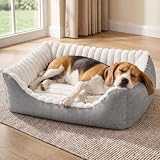
Avont Supportive Low-Entry Dog Bed
- Low step-in for stiff dogs
- Soft, warm nap surface
- Softer fill, less support

Most orthopaedic beds look much the same zipped into a cover on the shelf — the differences that matter are foam density, how the bed handles a heavy dog over the long haul, whether an arthritic dog can climb in at all, and how it washes. Get those right and a bed lasts years instead of flattening by the next winter. Our four picks deliberately span the size range — a low-entry bed for small, stiff seniors right up to an XX-large slab for giant breeds — so there's a fit whatever your dog weighs. Below: the five things to weigh, a side-by-side of our four picks, then the full rundown on each.
What to look for in an orthopaedic dog bed
The five details that matter most. Scroll across to read all five.
Foam density
Support comes from density, not just thickness. Light, airy foam looks deep, but a heavy dog compresses it flat to the floor within months; high-density or memory foam holds its shape and keeps the joints properly supported.
Height and entry
A tall bolstered sofa suits a dog that can still climb; a stiff, arthritic dog often does better with a low, easy step-in. Watch how your dog gets onto the couch now, then match the entry height to that.
Sizing
Measure your dog stretched out flat, nose to tail, and add room to spread. Beds are sold by breed guesswork that rarely matches a real dog, so one they hang off the edge of gets abandoned for the cool floor.
Washing and mess
Older dogs have accidents, and foam that soaks it up is a bed you throw out. Look for a removable, machine-washable cover over a waterproof inner liner, so spills stop at the foam instead of soaking in.
Cover and durability
The cover takes the daily grind — claws, washing, a dog that circles and digs before lying down. A tough woven cover and a non-slip base that stops the bed sliding on floorboards outlast a plush fabric that pills.
At a glance
Our top four picks compared — specs, prices, and our one-line take on each.
| Rank | Product | Best for | Key feature | Price guide | Check price link |
|---|---|---|---|---|---|
| Best Overall |  | Large dogs and arthritic seniors needing all-round support | Egg-crate orthopaedic foam with an L-shaped bolster and waterproof liner. | $$$ (size dependent) | Check price |
| Best for Large Breeds |  | Great Danes, Labs and other big, heavy breeds | Memory foam sized right up to XX-large for proper big-breed room. | $$$ (size dependent) | Check price |
| Best for Nesters |  | Dogs that curl up and lean into the sides | Four-sided bolster over egg-crate foam, with a removable 2-in-1 pad. | $$$ (size dependent) | Check price |
| Best for Easy Access |  | Small and medium seniors that struggle to climb | A low step-in over a resilient foam-and-fibre fill with a soft nap surface. | $$ (size dependent) | Check price |
Our picks in detail
What we love, what to watch out for, and who each pick suits best.
Best Overall: BFPETHOME Orthopedic Waterproof Sofa Dog Bed
Bottom line — the most complete pick for a big or ageing dog, pairing pressure-relieving egg-crate foam with a waterproof liner that survives real life.
This is the all-rounder — it does the important jobs well without a glaring weakness. The egg-crate orthopaedic foam is built to spread a heavy dog's weight and take the load off hips and elbows, and the L-shaped bolster gives a dog something to rest their head against instead of lying dead flat. It's designed around a big dog that needs proper support, not a token bit of padding.
The waterproof inner liner is the part that earns its keep with an older dog — accidents and spills stop at the liner instead of soaking into the foam, and the cover zips off for the wash. The XL runs about 106 × 76 cm, so measure before you commit and size up if your dog likes to sprawl. The downsides are the usual for a foam bed this size: the foam core can't go through the wash, it takes a day or two to loft out of the box, and it's heavy enough that you won't be shifting it room to room without noticing.
| What we love | Areas for improvement |
|---|---|
|
|
Best for Large Breeds: Anshine XX-Large Memory Foam Dog Bed
Bottom line — the pick when the problem is size, giving a giant-breed dog memory-foam support and enough surface to stretch right out.
If your dog is the reason the furniture keeps getting rearranged, this is the one. It's built at XX-large scale for the truly big breeds — Great Danes, bigger Labs, mastiff types — with memory foam that conforms to the body and eases the load on ageing joints. Plenty of beds claim to fit a large dog; this one gives a tall, long dog room to stretch right out.
The memory foam is the main event — it moulds to a heavy dog rather than propping them up on a firm slab, which suits older joints that don't like pressure points. The cover zips off for a machine wash, though it's a plain, practical affair rather than anything plush. The obvious catch is the size: it dominates a room and it's far more bed than a small or medium dog needs, so it's only worth buying if your dog fills it. For a big breed that keeps flattening ordinary beds, it's a sensible fit.
| What we love | Areas for improvement |
|---|---|
|
|
Best for Nesters: Pawz Orthopedic Dog Bed with Bolster
Bottom line — the pick for a dog that curls and burrows, with a four-sided bolster to lean against over supportive egg-crate foam.
Some dogs sleep flat out; plenty of others spend ten minutes circling and burrowing before they drop, then wedge themselves into a corner with their chin propped on something. This bed is built for that second type. The four-sided bolster gives a dog edges to lean and rest a head against, and underneath sits high-density egg-crate foam that takes the pressure off hips and elbows.
The clever bit is the removable inner cushion — lift it out and it works on its own as a flat travel mat, so the same bed covers the lounge room and the back of the car. The cover zips off for washing and there's a waterproof liner underneath for the inevitable. The trade-off is space: those raised sides look cosy, but they eat into the flat area, so a big dog that likes to sprawl right out can end up feeling boxed in. For a committed nester, though, the bolster is exactly what they're after.
| What we love | Areas for improvement |
|---|---|
|
|
Best for Easy Access: Avont Supportive Low-Entry Dog Bed
Bottom line — the gentle pick for a small, stiff senior, trading deep foam support for an easy low step-in and the lowest price here.
Not every senior needs a big supportive slab — some just need to get into bed without a struggle. This one's the low-entry option, with sides low enough for a small or arthritic dog to step over instead of clamber up. The fill is a resilient foam-and-fibre blend rather than dense memory foam, so it's soft and warm underfoot, and the cover has a plush, nest-like nap that smaller dogs settle into.
It's the pick for a little old dog that's more bothered by getting up onto a tall bed than by the firmness once they're there. Hidden zips keep chewers from picking at them, the base grips the floor rather than skating off across tiles, and the cover machine-washes without fuss. Just know what it isn't: the softer fill won't hold a big, heavy dog the way high-density foam does, and there's no XL size, so it's strictly a small-to-medium bed. Within those limits, it's the easiest bed here to live with and the kindest on the wallet.
| What we love | Areas for improvement |
|---|---|
|
|
FAQ
What makes a dog bed orthopaedic?
Do orthopaedic beds help dogs with arthritis?
What size orthopaedic bed should I get?
How do I clean an orthopaedic dog bed?
Is a special bed enough to manage my dog's arthritis?
Final thoughts
I've had enough older fosters come through to know a good bed changes how a stiff dog moves the next morning — less groaning getting up, more real sleep instead of shifting around all night. The trap is buying on plushness. Soft feels kind in the shop, but a heavy dog sinks straight through it and ends up on the floor anyway; dense, supportive foam is what does the work, even if it feels firmer to your hand.
My take: match the bed to the dog you've got, not the dog you wish you had. Measure them stretched out flat and size up, because a bed they hang off gets ignored. Spend where it counts — thicker, higher-density foam is worth the extra outlay for a big or arthritic dog — but a smaller senior who just needs an easy step-in and a soft nest doesn't need the priciest sofa in the range. Get the fit and the firmness right and the bed pays for itself in better sleep, which for an old dog is most of the battle.
We Think You’ll Also Like These Guides
 DOG
DOGBest Dog Cooling Beds in Australia: Ultimate Guide
A cooling bed gives your dog a chill spot when the mercury climbs. We picked the best for safe, no-power relief all summer.

 DOG
DOGThe Best Heated Dog Beds for Australian Winters: Ultimate Guide
A frosty morning is hard on an old dog. We found four heated beds — electric, cordless and no-plug — to keep your dog cosy through an Aussie winter.
 DOG
DOGDo Dogs Need Heated Beds in Winter? An Australian Guide
Do dogs really need heating, or just a warm spot? We weigh up the Aussie climate, your dog and when a heated bed actually makes sense this winter.